
MSP vs MSSP: What’s the Difference, and Which One Are You?
KEY TAKEAWAYS
- An MSP runs a client’s day-to-day IT. An MSSP runs a client’s security.
- There’s no single license that makes a company an MSSP. Buyers judge the MSSP label by what you actually deliver, such as monitoring and incident response.
- Many MSPs now sell security without becoming a full MSSP, and that middle ground is a strong place to be.
- The label you choose changes who you sell to, what triggers a buying decision and how your first sales call should sound.
- Pick the label that matches what you can deliver today, then build your outreach around that buyer.
Search “MSP vs MSSP” and most results are written for businesses trying to decide which one to hire. This guide is written for the other side of the table: the IT provider deciding what to call itself and how to sell.
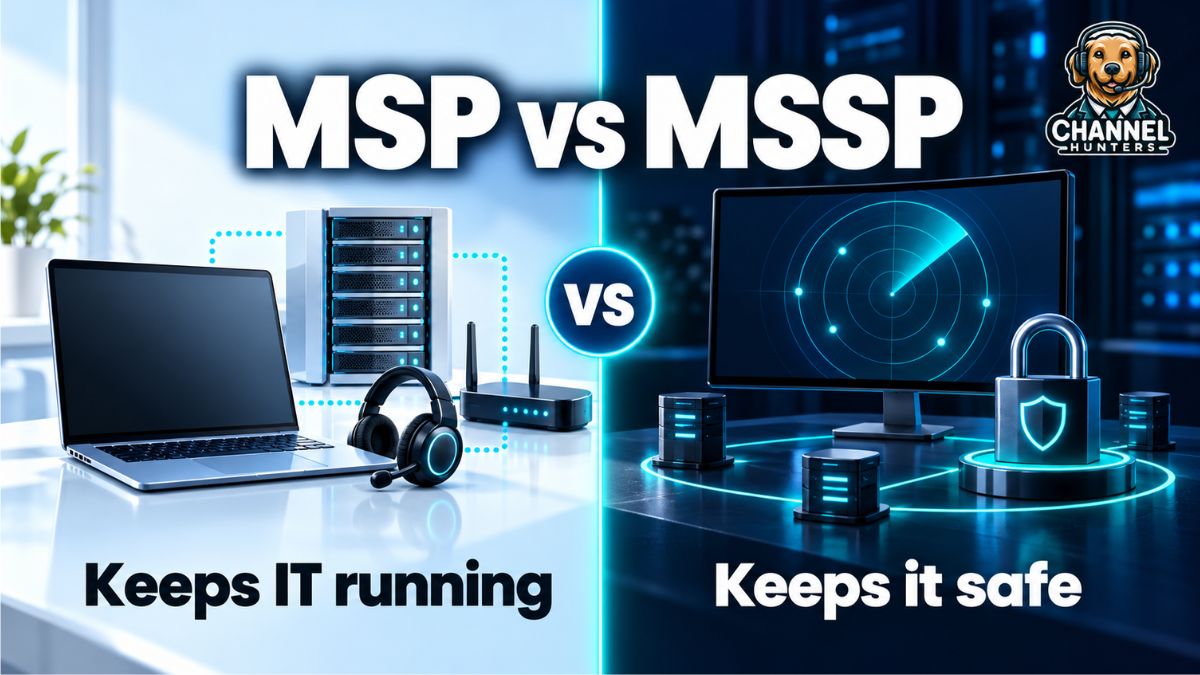
The short answer: A managed service provider (MSP) takes care of a client’s everyday IT, like the help desk, devices, networks, backups and cloud tools. A managed security service provider (MSSP) focuses on protecting that client, usually through security monitoring, threat detection and response, and security tool management. An MSP keeps things running. An MSSP keeps things safe.
The two overlap more and more, which is why the difference matters when you sell.
What Is an MSP?
An MSP is a company that manages a client’s IT for a recurring fee, usually under a monthly contract. Instead of calling for help when something breaks, the client pays for ongoing management.
A typical MSP handles:
- Help desk and end-user support
- Device, server and network management
- Patching and software updates
- Backup and recovery
- Cloud and Microsoft 365 administration
- Vendor management and IT planning
MSP buyers are usually small and mid-sized businesses without a large internal IT team. The person signing is often the owner, an office manager or CFO, or an IT lead who’s stretched thin.
What Is an MSSP?
An MSSP is a company whose main job is security. It watches for threats, responds when something happens and manages the tools that protect a client’s systems and data.
A typical MSSP offers some mix of:
- Security monitoring, often around the clock
- Threat detection and response
- Firewall and endpoint security management
- Vulnerability scanning
- Incident response support
- Help with security and compliance requirements
Many MSSPs run their own security operations center (SOC) or partner with one so someone is watching alerts at all hours.
For a look at the security basics small businesses are expected to cover, see Cybersecurity Best Practices to Prevent a Cyber Attack.
MSP vs MSSP: Side-by-Side Comparison

| MSP | MSSP | |
|---|---|---|
| Main focus | Keeping IT running | Keeping systems and data protected |
| Core services | Help desk, devices, network, backups, cloud | Monitoring, detection and response, security tools, compliance support |
| Typical hours | Business hours, often with limited after-hours support | Often 24/7 monitoring |
| Team skills | Broad IT skills | Specialized security skills |
| Typical buyer | Owner, office manager or CFO, IT lead | IT lead, compliance or risk owner, executive leadership |
| What triggers a purchase | Growth, IT problems, an unhappy current provider | An audit, an insurance requirement, a security scare |
MSSP Requirements: What It Takes to Call Yourself an MSSP
There’s no single license or certification that turns an MSP into an MSSP. In practice, buyers decide whether you’re an MSSP based on what you can deliver. Before you use the label, ask yourself honest questions:
- Can you watch for threats outside business hours? If alerts sit until Monday, many buyers won’t see you as an MSSP.
- Do you have a plan for when something goes wrong? Incident response is part of what security buyers pay for.
- Do you have people with real security skills, either on staff or through a partner? Security work needs specialists, either on staff or through a partner.
- Can you speak to compliance? Many security buyers need help meeting rules set by their industry, their customers or their insurer.
- Do you report on security, not just tickets? Security buyers want to know what was found and what was done about it.
If the answer to most of these is no, that’s fine. It means you’re an MSP that offers security services, and that’s a strong position on its own.
The Middle Ground: MSPs That Sell Security
The line between MSP and MSSP keeps getting thinner, because clients expect their IT provider to protect them.
Kaseya’s 2026 State of the MSP Report found that about 71% of MSPs reported year-over-year revenue growth in cybersecurity, and 61% say most or all of their clients turn to them for cybersecurity advice.
So the real question for many MSPs isn’t “Am I an MSSP?” It’s “How much security do I sell, and how do I talk about it?” Many providers land in the middle: a full MSP offering with a security package on top, sometimes delivered with a security partner behind the scenes.
Some providers also resell hardware and software. If that’s you, see What Is a Value Added Reseller (VAR)?
How the Label Changes the Way You Sell
This is where the choice matters most for sales. The label isn’t only a description. It decides who you call, when you call and what you say.
You’ll talk to different people
An MSP pitch often lands with the owner or office manager, who cares about uptime, responsiveness and cost. An MSSP pitch more often reaches an IT lead, a compliance or risk owner, or company leadership. These buyers care about risk, requirements and proof that someone is watching.
If you call yourself an MSSP but keep pitching help desk response times, the buyer will notice the mismatch.
Different events open the door
MSP prospects often start looking when they’re growing, when IT keeps getting in the way or when they’re unhappy with their current provider.
Security prospects often start looking because something forced the issue:
- An audit or a customer asking for proof of security controls
- A cyber insurance renewal with new requirements
- A security scare, either their own or a close peer’s
- New compliance rules in their industry
Knowing these triggers tells you when a call is likely to be welcome.
The first conversation sounds different
For an MSP, a good opening question might be: “When something breaks, how long does it usually take to get help?”
For an MSSP or a security-focused MSP, it might be: “If something suspicious happened on your network on a Saturday night, who would see it first?”
Same goal: a conversation, not a pitch. Different question, because the buyer worries about different things.
Your list changes too
An MSP can sell to almost any small business with computers. An MSSP list is usually narrower: businesses with compliance needs, sensitive data or larger customers asking hard questions. A tighter list means each call needs more research, and each meeting is often worth more.
If you’re deciding who should make those calls, read MSPs & MSSPs: Outsource Sales or Hire Internally?
Need someone working that list for you? Let’s Hunt!
Which One Should You Call Yourself?
Use the label that matches what you deliver today, not what you plan to deliver next year.
- Call yourself an MSP if your core work is managing IT and security is one part of it.
- Call yourself an MSP that offers managed security if you sell a real security package but don’t run 24/7 monitoring and response.
- Call yourself an MSSP if security is your main product and you can watch, respond and report around the clock, on your own or with a partner.
Getting this right protects your reputation. A buyer who hires an “MSSP” and gets help desk support won’t stay long.
How Channel Hunters Helps MSPs and MSSPs Fill Their Calendars
Whichever label fits, someone still has to reach the right buyer at the right time. Channel Hunters books qualified appointments with IT decision makers for MSPs, MSSPs and other IT channel companies.
Each client gets a dedicated Hunter who focuses on reaching decision makers, not gatekeepers.
Frequently Asked Questions
What does MSSP stand for?
MSSP stands for managed security service provider. It’s a company that manages a client’s security, usually through monitoring, threat detection and response, and security tool management.
Can an MSP also be an MSSP?
Yes. Many MSPs offer security services, and some grow into full MSSPs. The key is whether you can deliver what security buyers expect, especially monitoring outside business hours and a plan for responding to incidents.
Does an MSSP need its own SOC?
Not always. Many MSSPs run their own security operations center, but others partner with a SOC provider. What matters to buyers is that someone is watching and responding, not who owns the SOC.
Is an MSSP more expensive than an MSP?
Security services often cost more because they need specialized skills and, in many cases, around-the-clock coverage. Pricing varies widely, so compare what’s included rather than the label.
Which is better for a small business, an MSP or an MSSP?
It depends on the need. Many small businesses start with an MSP for everyday IT and add security services as their risks or requirements grow. Businesses with strict compliance needs may need an MSSP sooner.
Should my MSP become an MSSP?
Only if you can deliver what security buyers expect: monitoring outside business hours, a plan for responding to incidents, people with real security skills, help with compliance, and security reporting (not just tickets). If most of those are a no, it’s often better to stay an MSP that offers security services and build from there.
Ready to Reach the Right Buyers for Your MSP or MSSP?
Channel Hunters books qualified appointments with IT decision makers, so you can spend your time on conversations that move forward.
